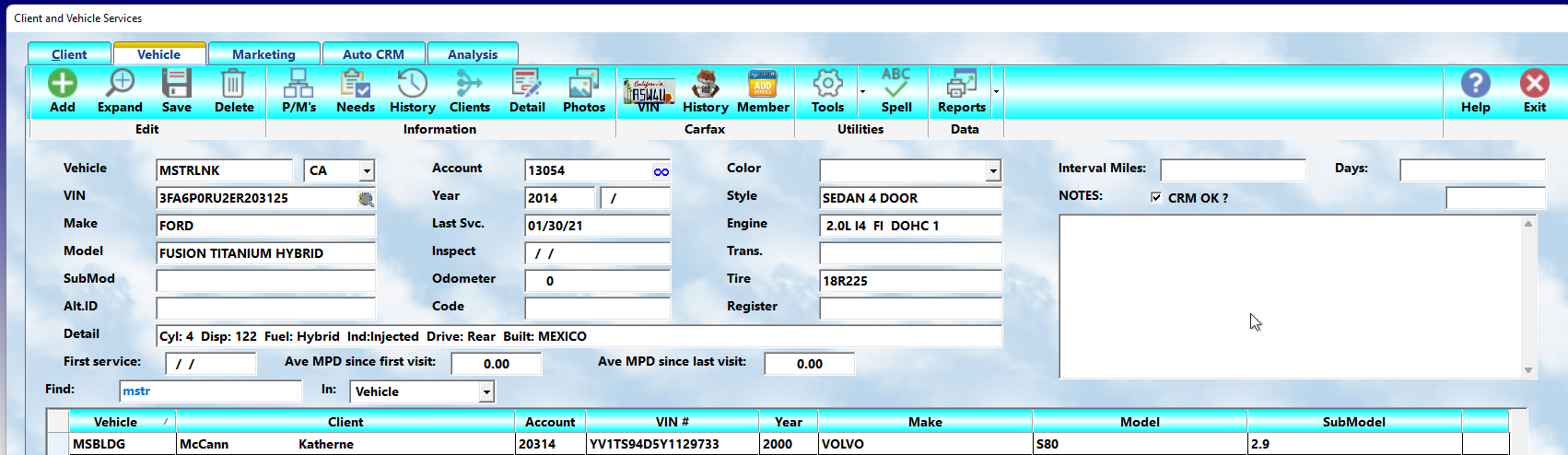
The Service Unit Data section maintains the detailed information for every serviced unit associated with a client account.
Originally designed for automotive repair facilities, MLS 2026 fully supports a wide range of service businesses. While automotive shops may track vehicles, the same structure can be used for:
•HVAC systems
•generators
•industrial equipment
•marine units
•motorcycles
•recreational equipment
•landscaping equipment
•power systems
•specialty machinery
•and many other serviceable assets
The Service Unit record connects:
•workorders
•estimates
•invoices
•preventive maintenance schedules
•service history
•inspections
•CRM activity
•reporting
•productivity tracking
throughout MLS 2026.
Service Unit Identification Standards
For automotive Service Units, the proper identifiers are:
•License Number
•VIN (Vehicle Identification Number)
These values are standardized and normally unique, making them ideal for tracking service history, workorders, maintenance schedules, and reporting.
For non-automotive Service Units, there is often no equivalent license or VIN structure. In these cases, MLS 2026 still requires that every Service Unit have a unique identifier.
The best practice is to use the actual manufacturer’s serial number whenever possible.
Examples may include:
•HVAC equipment serial numbers
•generator serial numbers
•industrial equipment IDs
•marine engine serial numbers
•compressor serial numbers
•equipment asset tags
However, many manufacturers may use similar numeric sequences that can overlap with other brands. To prevent duplicate records, MLS 2026 strongly recommends placing a short manufacturer prefix in front of the serial number.
Examples:
•HP-22033
•CAT-88471
•KOH-55192
•TRN-44721
This method:
•preserves uniqueness
•improves searching
•simplifies identification
•avoids duplicate Service Unit records
•improves reporting accuracy
It is important that the identifier remain consistent throughout the life of the Service Unit.
⚠️ Never reuse identifiers for different Service Units.
Even if a unit is retired or removed from service, the historical records should remain linked to the original identifier for long-term service history accuracy.
Using standardized identification methods greatly improves:
•workorder tracking
•inventory lookup
•maintenance scheduling
•reporting
•CRM integration
•historical searches
•technician efficiency
throughout MLS 2026.
Service Unit Controls
 Add
Add
Select Add to create a new Service Unit record.
In most cases, Service Units are added automatically during workorder creation. However, records may also be entered in advance if desired.
 Expand
Select Expand to open the Notes field in a larger editing window.
This provides:
•full-height editing
•larger text display
•easier review
•spell checking support
•Dictation capable text input
•AI support for spelling, grammar, presentation
Changes made in the expanded window are saved back to the Service Unit record when properly exited.
 Save
Save
Always select Save after making changes.
This stores the information in the primary Service Unit database.
⚠️ Unsaved changes may be lost.
 Delete
Select Delete to remove the highlighted Service Unit from the listing.
⚠️ Deleting Service Units is not recommended.
Deleting the Service Unit record does not remove:
•workorders
•invoices
•service history
•accounting records
The storage space recovered is insignificant, and deletion may complicate historical tracking.
 P/M’s
P/M’s
Select P/M’s to edit the Preventive Maintenance Schedule for the highlighted Service Unit.
For additional details, see:
👉 Preventive Maintenance Schedules
 History
Select History to display the complete service history for the highlighted Service Unit.
 Client
Select Client to display the client record associated with the Service Unit.
This view is informational only.
To edit the client record:
👉 use the lookup/search control inside the Account field.
 Detail
If the License or VIN is unavailable, select Detail to manually identify the Service Unit.
For automotive applications, this allows selection of:
•year
•make
•model
•submodel
The selected values automatically populate the Service Unit fields.
This standardized data greatly improves:
•reporting
•searching
•catalog integration
•labor lookups
•service consistency
 Photo
Photo
Select Photo to view photos associated with the highlighted Service Unit.
 License To VIN ( Activated for Automotive Repair Facilities )
If the License and State are known but the VIN is missing, select:
👉 License To VIN
MLS 2026 will query the integrated database service and attempt to retrieve the VIN.
The VIN may then be decoded automatically to populate the Service Unit information.
This feature is especially useful when:
•historical records are incomplete
•labels are missing
•VIN plates are inaccessible
 Carfax ( Activated for Automotive Repair Facilites )
Select Carfax to display available service history information for the highlighted automotive Service Unit.
This may include:
•prior maintenance
•reported repairs
•mileage history
•service events
based on available records.
 Tools
Tools
The Tools menu contains Service Unit utilities, including:
•License Change
•maintenance tools
•future utility additions
 Reports
The Reports option provides access to Service Unit reports.
One example is the:
👉 Vehicle Expense Report
which displays repair costs over a selected date range.
 Spell
Spell
Select Spell to check spelling in the Service Unit notes.
 Help
Help
Select Help to open the manual.
You may also press:
👉 F1
to open help directly to the page for this window.
 Exit
Exit
Select Exit to close the Service Unit window.
The Service Unit Data Screen
The following information is maintained for each Service Unit.
License
The License field is a primary identifier and links the Service Unit to:
•workorders
•invoices
•service history
•related records
⚠️ Do not manually change the License value directly in the record.
Instead, use:
👉 Tools → License Change Utility
to properly update the information.
MLS 2026 strongly recommends using the actual license or assigned identification value whenever possible.
Using partial VIN numbers or unofficial identifiers may create duplicate or conflicting records.
If a license is transferred to another unit:
1.Change the original identifier using the License Change Utility
2.Create the new Service Unit using the correct current license
This preserves historical integrity.
VIN Number
The VIN is the unique serial number assigned to the Service Unit.
For automotive Service Units, MLS 2026 includes automatic VIN decoding.
When supported by the VIN structure, the decoder can automatically populate:
•year
•make
•model
•submodel
•detail information
•standard industry coding
The VIN decoder may activate automatically:
•during workorder creation
or
•when using the lookup icon next to the VIN field
Proper VIN information greatly improves:
•parts ordering
•catalog integration
•labor guide matching
•service verification
Make
The manufacturer name for the Service Unit.
Examples:
•Toyota
•Carrier
•Honda
•Kohler
•John Deere
Model
The manufacturer’s model designation for the Service Unit.
Submodel
Additional model detail or trim level information.
Alternate ID
The Alternate ID field may be used for:
•secondary serial numbers
•fleet numbers
•internal IDs
•customer equipment numbers
⚠️ The complete VIN or primary serial number should always remain in its proper field whenever possible.
Detail
The Detail field stores additional brief information about the Service Unit.
The VIN decoder may automatically populate important details into this field.
Examples may include:
•engine type
•equipment package
•drivetrain
•special configuration
•service classification
First Service
The date the Service Unit was first serviced by your business.
This provides:
•historical tracking
•client longevity reference
•service age information
Average Miles Per Day Since First Visit
MLS 2026 automatically calculates the average usage rate since the first recorded service visit.
For non-automotive applications, this may represent:
•operating hours
•usage cycles
•accumulated activity
depending on how the business tracks Service Units.
Average Miles Per Day Since Last Visit
This value calculates average usage since the most recent service visit.
This information is useful for:
•maintenance forecasting
•service interval planning
•CRM reminders
•preventive maintenance scheduling
Account
The Account field links the Service Unit to a specific client record.
Changing the account number transfers ownership of the Service Unit to another client.
This is especially useful when:
•equipment is sold
•ownership changes
•fleet assignments change
All related history remains intact.
Year
MLS 2026 tracks:
•model year
•production month/year
when applicable.
Last Service / Inspection / Odometer
The system automatically updates:
•last service date
•latest meter reading
•odometer information
from completed workorders.
The Inspection Date field may be used to schedule:
•annual inspections
•certifications
•safety checks
•regulatory reviews
Reminder notices may then be generated prior to the due date.
Code
For automotive applications, the VIN decoder may assign an industry-standard classification code.
This assists:
•catalog interfaces
•labor systems
•reporting
•integration products
These values generally should not be changed manually.
Color
Stores the Service Unit color information.
Style
Used to describe the physical construction or configuration of the Service Unit.
Examples:
•4 Door
•Hatchback
•Rooftop Unit
•Portable Generator
•Walk-Behind
•Trailer Mounted
Engine
Stores information about the engine or motor system.
Examples:
•engine family
•displacement
•motor type
•manufacturer model number
Transmission
Stores transmission or drive system information when applicable.
Tire
Stores wheel and tire size information when applicable.
State Registration
Some states or jurisdictions assign registration identifiers separate from:
•VIN
•license
These values may be stored here.
Service Interval Miles / Days
Reserved for automated maintenance scheduling and CRM development.
Typical examples:
•5,000 miles
•90 days
•250 operating hours
These values help project future service needs.
CRM OK?
By default, this field is enabled.
When active, selected service information may be transmitted to approved CRM or reporting services.
For automotive applications, this may include:
•service type
•mileage
•service dates
⚠️ Client financial information is not transmitted.
Disable this field only when specifically requested by the client.
This should remain a rare exception rather than normal practice.
Notes
The Notes field stores Service Unit-specific information.
Examples may include:
•special operating conditions
•modifications
•warnings
•recurring concerns
•special instructions
•equipment configurations
These notes are visible during workorder processing.
Why Service Unit Data Matters
The Service Unit record is one of the central operational components of MLS 2026.
It connects:
•clients
•workorders
•service history
•preventive maintenance
•CRM systems
•reporting
•inventory
•labor history
•recommendations
into a unified service record.
Accurate Service Unit information improves:
•service consistency
•customer communication
•reporting accuracy
•maintenance forecasting
•parts identification
•technician productivity
throughout the entire MLS 2026 system.
Recommended Best Practices
•Always use the true license or primary identifier
•Enter complete VIN or serial number information whenever possible
•Use standardized Make/Model/Submodel data
•Avoid manually changing license identifiers
•Keep inspection dates current
•Use notes for recurring service concerns
•Maintain accurate ownership/account links
•Use CRM reporting responsibly
•Review preventive maintenance schedules regularly
•Preserve Service Unit history whenever possible
Recommended Companion Sections
This section works closely with:
•Client Data
•Workorders
•Preventive Maintenance Scheduling
•CRM Integration
•Service History
•Labor Glossaries
•Inventory
•Reporting
•Interface Products
•Vehicle / Service Unit Utilities
Together, these sections provide the operational foundation for managing complete client and Service Unit service history within MLS 2026.