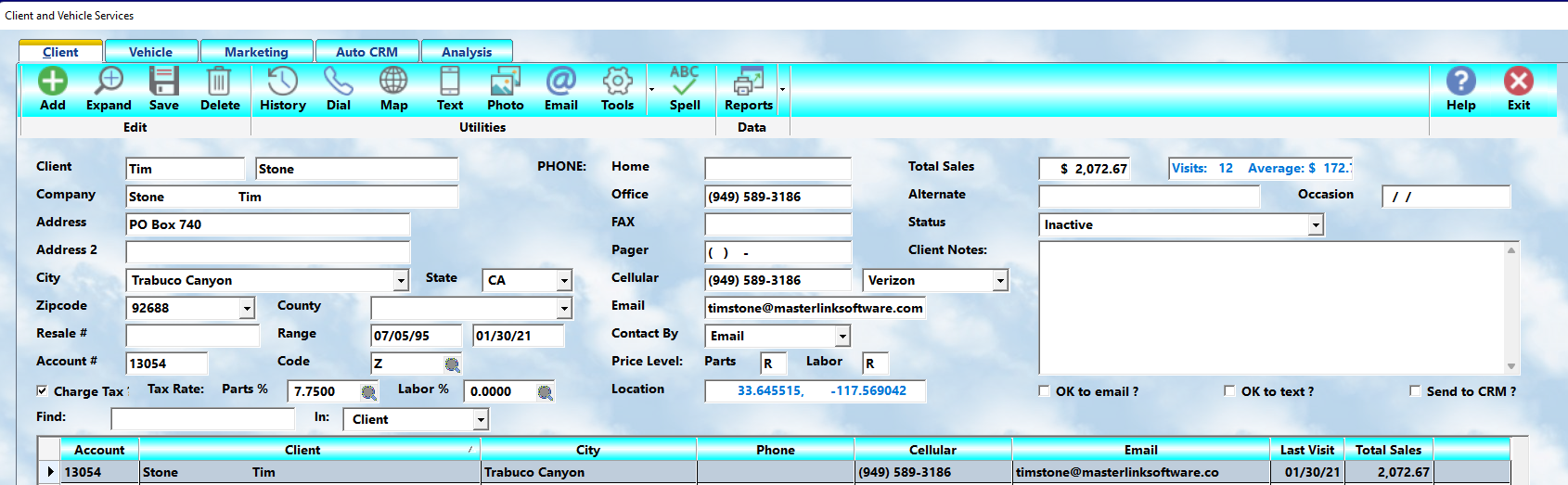
Controls
 Add: To add a new account, simply select the button. When the data screen on the top is then displayed with empty boxes, fill in the blanks as appropriate.
 Expand Select this button to bring up the text in a larger display format ( full window height, larger font ). You may make changes on the popup window, including the use of the spell checker, and your results will be saved to the actual client record upon exiting the window.
 Save Always press this button after making changes to your program. This will save the information / changes to the main database.
 Delete If you select this button while a record is highlighted, you can delete the client. Deleting clients is not recommended. The record takes up very little space on your computer, and is a link for all of the individual service units you may have remaining in the system. If you must delete records, be sure to use the utility which removes all service units first, and all associated records.
 History When you press this History button, MasterLink Shop Writer will automatically display the service history for all visits by the highlighted client. This includes all vehicles they own.
 Map Display a map of the client's area
 Dial Use the built in phone dialer ( modem must be connected to the phone line ) to call a displayed number of the highlighted client.
 Text The Text button allows you to send a text message to the client's cell phone. You must have both a cell phone number, and their service provider, for this to work from your computer. Please complete those fields when the client visits.
 Photo View the photos associated with the selected client
 Email Send an email to the displayed client
 Tools The tools are used to perform maintenance and updating services to the client records. Details are found in Client / Vehicle Utilities
 Spell Check the spelling on the notes for the selected client
 Reports This button provides a drop down list of Reports you can run specific to your clients.
 Help Open the manual and lookup information. ( Open to the page for this window by pressing the F2 key instead ).
 Exit Exit the client dialog window.

The Client Data screen is used to maintain the primary information for each customer or business account in MLS 2026.
Client records are the foundation for:
•Service Units
•workorders
•estimates
•invoices
•service history
•contact information
•pricing levels
•tax settings
•CRM follow-up
•reporting
Because many areas of the system link back to the client account, client records should be created carefully and deleted only with extreme caution.
Client Controls
Add
Select Add to create a new client account.
The upper data fields will be cleared so the new client information can be entered.
After completing the fields, select:
👉 Save
to store the new account.
Expand
Select Expand to open client notes in a larger editing window.
This provides:
•full window height
•larger text display
•easier note editing
•spell checking support
•Dictation mode
•AI reformatting
Changes made in the expanded window are saved back to the client record when the window is closed properly.
Save
Always select Save after adding or changing client information.
This stores the current information in the main client database.
⚠️ If Save is not selected, changes may be lost.
Delete
Select Delete to remove the highlighted client record.
⚠️ Deleting clients is strongly discouraged.
Client records take very little storage space and may be linked to:
•Service Units
•workorders
•invoices
•history
•reports
•accounting records
If a client must be deleted, first use the proper utility to remove all associated Service Units and related records.
History
Select History to display the complete service history for the highlighted client.
This includes work performed on all Service Units owned by that client.
Map
Select Map to display a map of the client’s area.
This may be useful for:
•locating the client
•delivery reference
•service calls
•geographic review
Dial
Select Dial to call the displayed client phone number using the built-in phone dialer.
A modem must be connected to the phone line for this feature to operate.
Text
Select Text to send a text message to the client’s cell phone.
For this feature to work, the client record must include:
•cell phone number
•cell service provider
Be sure to complete these fields when the client visits.
Photo
Select Photo to view photos associated with the selected client.
Email
Select Email to send an email to the displayed client.
A valid email address must be entered in the client record.
Tools
The Tools menu provides maintenance and update functions for client records.
Additional details are found in:
👉 Client / Service Unit Utilities
Spell
Select Spell to check spelling in the notes for the selected client.
Reports
Select Reports to display a drop-down list of reports related to client records.
Help
Select Help to open the manual.
You may also press:
👉 F1
to open help directly to the page associated with this window.
Exit
Select Exit to close the Client Data window.
Editing A Client Account
When a client is highlighted in the browse list, the full client record appears in the upper section of the window.
To edit a client:
1.Highlight the client in the browse list
2.Make the desired changes
3.Select Save
The updated information will then be stored in the client database.
Client Account Data
The following information is maintained for each client.
Company
The Company field contains:
•the company name
or
•the individual client name in last-name / first-name order
This is the primary field used for locating clients.
MLS 2026 maintains this field alphabetically for browsing and searching.
Client First / Last Name
Enter the first and last name of:
•the individual client
or
•the responsible contact person at a company.
For individual clients, MLS 2026 automatically reverses the first and last name and stores the searchable format in the Company field.
Address / Address 2
Enter the client’s street address.
Use the second address line for:
•apartment numbers
•suite numbers
•building numbers
•additional delivery information
City
Enter the full city name.
Avoid abbreviations whenever possible.
County
Enter the county where the client resides or conducts business.
This can be useful for:
•tax reporting
•geographic reports
•local compliance
•business analysis
State / Zip
Enter:
•the standard two-letter state code
•the complete ZIP code when available
This information is important for:
•mailings
•CRM follow-up
•reports
•geographic sorting
Resale Number
If the client has a resale certificate, enter the resale number in this field.
This may be required for:
•tax-exempt sales
•wholesale reporting
•resale documentation
Account Number
Each client is assigned a unique account number.
When adding a new client:
👉 MLS 2026 assigns this number automatically.
The account number cannot be changed.
This number links the client to:
•Service Units
•workorders
•invoices
•history
•accounting records
•reports
Allowing manual changes to account numbers can create serious data problems, so the system protects this field.
Phone Numbers
Enter all available phone numbers, including:
•home
•business
•cellular
•fax
•pager
Always include area codes, especially in larger metropolitan areas.
Enter the client’s valid email address.
This may be used for:
•communication
•invoices
•estimates
•follow-up
•CRM activity
Contact By
Use the drop-down list to select the client’s preferred contact method.
Examples may include:
•phone
•text
This helps employees communicate with the client in the method they prefer.
Range / Last Sale
Whenever a workorder is completed for the client, the system updates the last sale date.
This provides a quick reference to the most recent activity for the client.
Code
The Code field is used to assign clients into user-defined groups.
Examples may include:
•how the client found the shop
•service frequency
•type of Service Unit
•account category
•marketing group
•customer rating
Codes are established in the Setup lists and selected from the available options.
Price Level
Every client is assigned a price level.
By default, clients are normally assigned:
👉 Retail
However, a client may also be assigned one of four wholesale levels:
•Level 2
•Level 3
•Level 4
•Level 5
This price level is used when the client purchases parts:
•across the counter
•on a workorder
•as part of a service
The assigned level appears automatically during parts entry, although it may be changed during processing if needed.
Occasion
Use this field to record a special client date, such as:
•birthday
•anniversary
•account anniversary
•other reminder date
Charge Tax
Use the tax fields to determine whether the client is charged sales tax.
If the client is tax exempt:
👉 leave the Charge Tax field unchecked.
If the client should be charged tax:
👉 check the field
and assign the proper tax rates for:
•parts
•labor
Use the lookup icon to select valid tax rates.
⚠️ Do not type tax values manually.
New tax rates should be added through:
👉 Tools / Setup Lists
before being assigned to clients.
Total Sales
MLS 2026 automatically accumulates total workorder sales for the client.
This allows management to review:
•client value
•sales volume
•account activity
•business history
Alternate
Use this field for secondary names or alternate references.
Examples may include:
•spouse
•partner
•fleet contact
•alternate authorized person
•secondary business name
Send To CRM?
MLS 2026 can work with third-party Customer Retention Management systems.
Normally, client data may be submitted for CRM follow-up.
However, some clients should not receive follow-up activity, such as:
•out-of-area travelers
•one-time drop-ins
•temporary contacts
•special situations
When CRM services are configured, a utility can mark clients last serviced after a selected date.
The operator may then uncheck clients who should not be submitted.
Clients with no Service Unit activity since the selected cutoff date are already excluded.
Status
The Status field is user-defined.
Status options are created in the Lists utility and may be assigned to client records.
Examples may include:
•active
•inactive
•fleet
•wholesale
•do not contact
•special handling
Notes
The Notes field is used for storing information about the client.
Examples may include:
•communication history
•special instructions
•billing notes
•preferences
•authorization details
•service concerns
Use the editing keys as described in the Basic Concepts section.
When finished, save the note properly.
⚠️ If you exit without saving, the note changes may be lost.
Find & In Boxes
The Find box displays the characters currently being typed for the search.
The In box shows which field is being searched.
The triangle symbol on the browse column header indicates:
•the active search column
•ascending or descending sort order
This allows quick searching and positioning within the client list.
Why Client Data Matters
Client records are more than names and addresses.
They connect the entire service relationship, including:
•Service Units
•workorders
•history
•pricing
•tax handling
•communication
•reporting
•CRM follow-up
Accurate client data improves:
•customer service
•billing accuracy
•follow-up communication
•service history tracking
•management reporting
throughout MLS 2026.
Recommended Best Practices
•Enter complete contact information whenever possible
•Use consistent company and client naming
•Always include area codes in phone numbers
•Record email and cell provider information when available
•Use proper tax rate lookup rather than manual entry
•Avoid deleting client records
•Use notes for important client instructions
•Assign meaningful client codes and status values
•Review contact preferences regularly
•Keep CRM eligibility accurate
Recommended Companion Sections
This section works closely with:
•Service Unit Records
•Workorders
•Estimates and Invoices
•Client History
•CRM Follow-Up
•Tax Setup
•Pricing Levels
•Client Reports
•Client / Service Unit Utilities
Together, these sections provide a complete client and service relationship management workflow within MLS 2026.