The Header section contains the information necessary to identify, track, process, and complete a specific service job. Much of this information controls how the workorder behaves throughout MLS 2026, including scheduling, billing, status tracking, taxation, client communications, and service history.
The information entered here becomes part of the permanent service record for both the client and vehicle. Careful completion of the header information improves workflow, customer communication, accounting accuracy, and long-term service tracking.
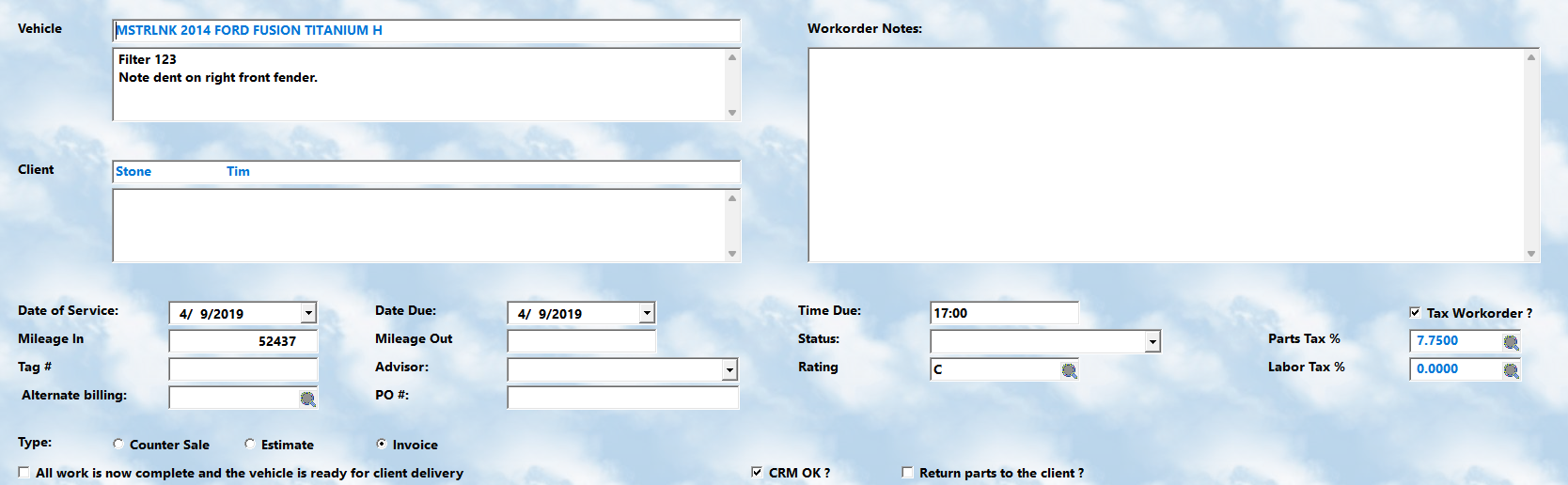
Vehicle / Client
These fields contain summary information from the actual Vehicle and Client records stored within the system databases. The smaller lines display summary information, while the larger note areas may contain special comments attached to the client or vehicle records.
If you select a vehicle, the associated client record is automatically attached to the workorder.
If you wish to modify the displayed information:
•Use the dropdown button next to Vehicle or Client
•Select View Information
Fields shown in black may be edited directly. When you exit the popup window, the changes will automatically be saved back to the master Client and/or Vehicle records.
Date of Service
The system automatically inserts the current date when the workorder is first created.
When the workorder is closed, MLS 2026 will normally update the final service completion date automatically. This is especially helpful for long-term projects such as restorations or major repairs that may remain open for extended periods.
Odometer In / Out
The current odometer reading should always be entered carefully.
Most states require mileage to appear on the final invoice. In addition, MLS 2026 uses mileage for:
•Preventative maintenance tracking
•Service recommendations
•Vehicle history
•Warranty support
•CARFAX reporting
For equipment other than automobiles, this may represent:
•Clock hours
•Meter readings
•Equipment usage hours
Tag
The Tag # field stores the internal identification number assigned by the shop.
This may correspond to:
•A mirror tag
•Key tag
•Windshield number
•Hood tag
•Internal routing number
This can help technicians and office staff quickly identify the vehicle while it is in the facility.
Alternate Billing
Sometimes the vehicle owner is not the party responsible for payment.
Examples include:
•Warranty companies
•Fleet billing offices
•Corporate headquarters
•Insurance companies
•Parent companies
Press the lookup button and select the Accounts Receivable account to which charges should be billed.
When the workorder is closed:
•Charges will be applied to the alternate account instead of the vehicle owner.
Delivery Date / Time
The expected completion date and time should be entered whenever possible.
MLS 2026 uses this information to:
•Monitor overdue work
•Flag approaching delivery deadlines
•Improve scheduling visibility
•Help coordinate shop workflow
Proper use of delivery times improves customer satisfaction and internal organization.
Service Advisor
Enter the name or code of the Service Advisor who accepted the vehicle or is managing the repair.
This information may later be used for:
•Reporting
•Productivity tracking
•Commission calculations
•Internal management
The lookup list is populated from the Writers Validation List.
PO Number
If the work is associated with a Purchase Order, enter the PO number in this field.
This is especially important for:
•Fleet accounts
•Government accounts
•Corporate billing
•Warranty claims
Status
Each workorder may be tracked using a variety of status values.
Examples include:
•Waiting
•Working
•Hold
•Sublet
•Testing
•Ready
The current status is displayed:
•On the main Workorder Manager screen
•In graphical status displays
•On scheduling views
Be sure to press Save after modifying the status.
Rating / Source
The Rating or Source code is normally inherited from the Client record.
This is commonly used to track:
•Advertising effectiveness
•Referral sources
•Customer classifications
•Marketing campaigns
The value may be changed for an individual workorder if needed.
Type
The Type field determines whether the workorder is:
•Estimate
•Invoice
•Counter Sale
When an Estimate is approved, use the Convert utility to change the workorder from:
•E (Estimate)
to
•I (Invoice)
During conversion:
•Parts
•Labor
•Totals
•Recommendations
will all transfer automatically into invoice processing mode.
Return Parts
This checkbox indicates whether removed parts should be retained for the customer.
It is generally safest to hold removed parts until:
•The customer picks up the vehicle
•The customer declines the parts
This helps avoid misunderstandings and may assist with:
•Insurance claims
•Warranty discussions
•Customer confidence
Tax
The Tax checkbox determines whether sales tax will apply to the workorder.
By default:
•Tax settings come from the Client record
•Tax rates come from system defaults
Because MLS 2026 supports multiple tax rates, you may modify:
•Parts tax rates
•Labor tax rates
for individual workorders when necessary.
Be sure to Save changes after modifying tax information.
CRM OK ?
If your shop participates in the CARFAX Service Program, this box will normally be checked automatically.
If you do NOT want this workorder submitted to CARFAX:
•Uncheck the box
Only limited service information is transmitted.
Work Complete
This checkbox should be selected when all technician work has been completed, even if payment has not yet been posted.
This alerts office personnel that:
•The work is finished
•The vehicle may be ready for pickup
This is especially helpful in busy multi-technician environments.
Workorder Notes
Workorder Notes are extremely important.
This section should contain:
•Customer concerns
•Symptoms reported
•Diagnostic observations
•Special handling instructions
•Alarm codes
•Delivery requests
•Internal notes
These notes print on the Technician Worksheet and become part of the permanent service record.
Good notes improve:
•Diagnostic accuracy
•Customer communication
•Technician efficiency
•Legal protection
•Service consistency
Detailed documentation is always recommended.