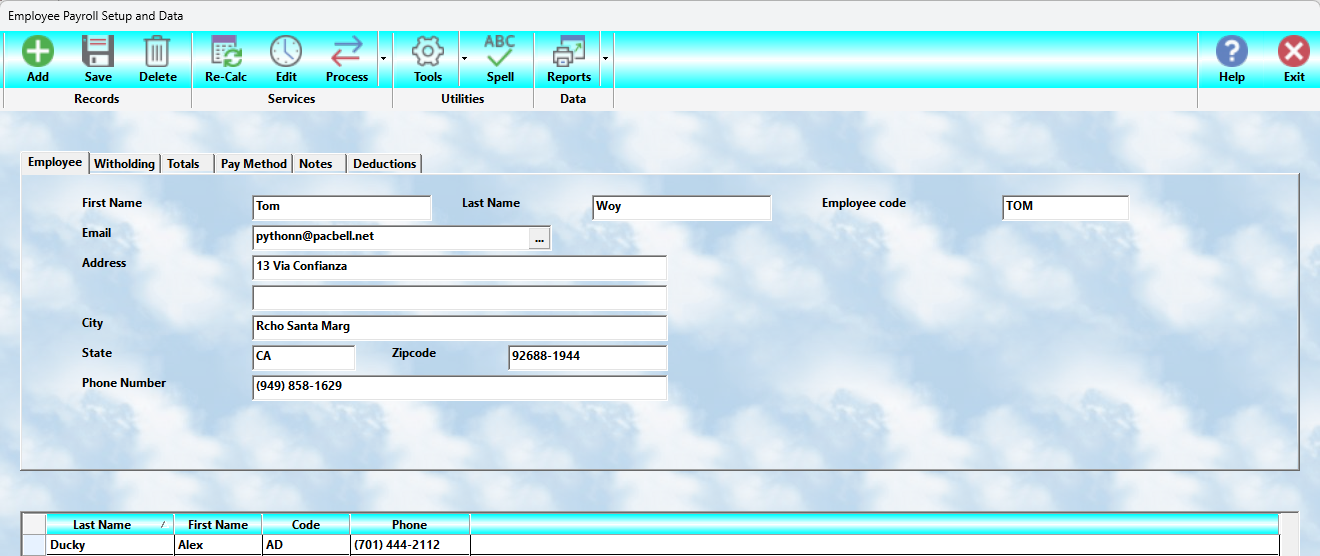
The Employee Data Editor (EDE) is the central location for maintaining employee payroll information within MLS 2026.
Because employees may:
•be paid differently
•have different deductions
•receive commissions
•work under different compensation plans
each employee must have an individual payroll record.
The Employee Data Editor maintains:
•employee identification information
•payroll settings
•withholding information
•deduction records
•pay calculation methods
•payroll totals
•notes and history
Employee Data Editor Layout
The Employee Data Editor contains:
•a browse list of employees in the lower section of the screen
•multiple folders (tabs) across the upper portion
These folders organize information such as:
•basic employee data
•withholding settings
•payroll totals
•pay calculation methods
•employee notes
As you highlight employees in the browse list, the upper sections automatically update to display the selected employee’s information.
Employee Processing Controls
The following controls are available on the Employee Data Editor screen.
 Add
Add
Use:
👉 Add
to create a new employee record.
⚠️ Important:
Never overwrite an old employee record simply because the employee no longer works for the company.
Always create:
•a new employee record
for new personnel.
This prevents:
•payroll history corruption
•reporting contamination
•W-2 inaccuracies
•year-end calculation problems
 Save
Save
Use:
👉 Save
to permanently save:
•additions
•edits
•payroll changes
made to the highlighted employee record.
⚠️ Changes are not retained until the Save button is selected.
 Delete
Use:
👉 Delete
to remove an employee record.
⚠️ Use extreme caution with this option.
Do NOT delete employees who:
•worked during the current year
•received payroll
•appear on reports
•require W-2 reporting
Deleting active payroll records can create:
•reporting errors
•missing payroll history
•tax reporting problems
In most situations, former employees should simply remain inactive within the system.
 Re-Calc
Use:
👉 Re-Calc
to:
•recalculate payroll totals
•verify employee balances
•refresh payroll history totals
This can be especially useful if:
•data corruption is suspected
•totals appear incorrect
•adjustments were made manually
 Edit
Edit
Use:
👉 Edit
to:
•edit employee timecards
•create manual timecards
•adjust payroll time information
This option is commonly used when:
•correcting hours
•entering missed time
•handling special payroll adjustments
 Process
Use:
👉 Process
to access payroll processing functions from the dropdown menu.
These functions include:
•payroll preparation
•paycheck processing
•payroll accounting
•payroll posting
The Process menu controls the actual payroll cycle workflow.
 Reports
Use:
👉 Reports
to access Payroll reports.
These reports include:
•payroll summaries
•employee earnings
•tax reports
•deduction reports
•payroll registers
•year-end reports
 Tools
Tools
Use:
👉 Tools
to access Payroll setup utilities and support functions.
These utilities control:
•payroll configuration
•deduction setup
•tax tables
•payroll defaults
•other system-wide payroll settings
Please review the:
👉 Payroll System Setup / Utilities
section carefully before processing payroll.
Basic Employee Data
Each employee record contains:
•employee name
•address
•phone number
•employee code
The:
👉 Employee Code
is extremely important because it connects:
•payroll
•workorders
•commissions
•labor tracking
•payroll reports
throughout MLS 2026.
Choosing Employee Codes
Although any code may technically be used:
👉 simple, recognizable codes are strongly recommended.
Most businesses use:
•initials
•first names
•abbreviated technician names
because they are easier to recognize on:
•workorders
•invoices
•payroll reports
•technician productivity reports
Example:
•JS = John Smith
•MIKE = Mike Johnson
•RB = Robert Brown
Consistent naming makes payroll and labor tracking much easier.
Why Employee Setup Matters
The employee record controls:
•how employees are paid
•how taxes are calculated
•how commissions are tracked
•how payroll posts to accounting
Accurate setup is critical for:
•payroll accuracy
•tax reporting
•labor costing
•year-end processing
A few extra minutes spent reviewing employee setup can prevent many payroll problems later.
Recommended Best Practices
When setting up employees:
•Use consistent employee codes
•Verify all personal information carefully
•Review withholding setup thoroughly
•Confirm deduction settings
•Keep payroll records current
•Never overwrite old employee records
Recommended Companion Sections
This section works closely with:
•Payroll Overview
•Employee Record Setup
•Employee Setup Overview
•Payroll Processing
•Payroll Reports
•Costing Setup
•Payroll Troubleshooting
Together, these sections provide a complete employee payroll management workflow within MLS 2026.