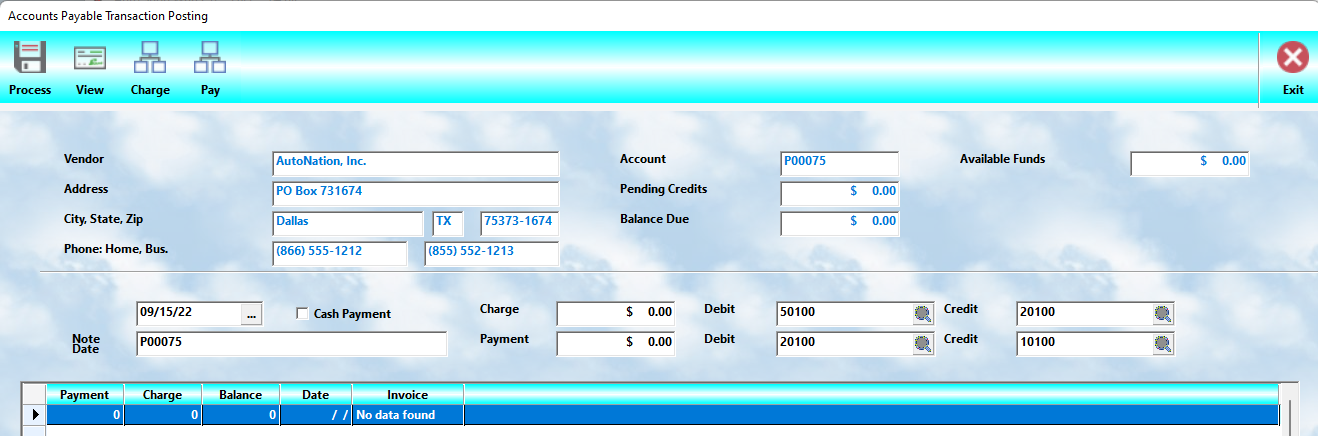
 Process
Finalizes and saves all payment entries.
When selected, MLS 2026:
•Applies payments
•Creates checks
•Updates vendor balances
•Posts entries to the General Ledger
⚠️ If you do not select Process, no payments will be saved.
 View
View
Displays a preview of the check exactly as it will print using the currently entered data.
 Charge
Allows a vendor charge to be distributed across multiple General Ledger expense accounts.
Pay
Allows payments to be distributed across multiple General Ledger accounts.
This is useful when:
•Multiple departments share expenses
•Payments must be allocated between accounts
 Exit
Exit
Closes the transaction screen for the selected vendor.
Payment Data Fields
Vendor Information
Displays:
•Vendor name
•Address
•Contact information
Vendor information is edited from the main Accounts Payable screen.
Account
The vendor’s assigned Accounts Payable account number.
Available Funds
Displays unapplied funds currently available for payment distribution.
Pending Credits
Displays vendor credits available for this account.
Balance Due
Shows the current outstanding balance owed to the vendor.
Date
The processing date for this transaction.
Cash Payment
Select this option when the vendor was paid directly with cash.
Typical uses:
•Delivery payments
•Small local purchases
•Immediate payment transactions
Note
Used to record:
•Check numbers
•Invoice references
•Vendor notes
•Other transaction details
Charge
The amount being added to the vendor account as a payable.
Payment
The amount being paid.
This may include:
•A single invoice
•Multiple invoices combined into one payment
Debit / Credit Accounts
The General Ledger account numbers used for posting charges and payments.
Always verify these values before processing.
Payment Processing Workflow
Step 1 — Select Payment Cycle
First select the payment cycle to process.
Examples:
•Weekly
•Monthly
•Special vendor groups
Only vendors assigned to the selected cycle will appear in the vendor list.
Highlight the vendor account you wish to process.
Step 2 — Open the Posting Screen
Select Post.
(Insert payment processing screen image here.)
The vendor’s open invoices will now be displayed.
Step 3 — Select Invoices to Pay
Double-click each invoice you wish to pay.
MLS 2026 will:
•Display the amount due
•Allow adjustment of the payment amount
•Apply the payment to the selected invoice
You may:
•Pay the invoice in full
•Make a partial payment
As invoices are selected:
•The Payment total increases automatically
Continue until all desired invoices are selected.
Payment Distribution
Payments are normally applied using the default Debit and Credit accounts shown on the screen.
If necessary, you may:
•Change the account on the Payment line
•Use the Pay button to distribute payments across multiple G/L accounts
Step 4 — Process the Payment
Once all invoices and payment amounts are correct:
•Select Process
MLS 2026 will:
•Save payment activity
•Prepare checks
•Update balances
Printing Checks
After processing, MLS 2026 asks whether checks should be printed.
Step 1 — Select Bank Account
Choose the bank account from which the checks will be drawn.
Step 2 — Choose Check Method
You may:
•Print checks automatically through MLS 2026
•Enter manually written check numbers
Automatic Check Printing
MLS 2026 will:
•Assign check numbers automatically
•Print checks directly
•List invoices on the check stub (space permitting)
Manual Checks
If manual checks are used:
•The system prompts for the assigned check number
•Payments are still posted normally
Final Processing
After checks are completed, MLS 2026 performs final accounting updates.
The system:
•Posts payments to vendor history
•Updates balances
•Writes entries to the General Ledger
This is the final step because all payment information must be correct before accounting entries are finalized.
Important Reminder
👉 Payment cycles should match the periods when vendors expect payment.
Using organized cycles:
•Simplifies processing
•Improves cash flow management
•Helps maintain strong vendor relationships
Best Practices
•Post invoices promptly when received
•Verify invoice selections carefully before processing
•Confirm G/L accounts before printing checks
•Process payments regularly to avoid overdue balances
•Use Notes for check and invoice tracking